Bold: Local Chat & Date
- 4.7
- Rating
- 10.00K
- Installs
- Free
- Price
 Analysis by App-foxy
I approached Bold: Local Chat & Date as a social discovery app rather than just another dating download. Its central idea is simple: help people find nearby connections, match, and begin chatting without a complicated setup. After spending time with it, my view is that Bold works best when you want a direct, location-focused way to meet people and are willing to be selective about how you use it. It is less convincing for anyone looking for a deeply detailed matchmaking system or a quiet, low-pressure social experience.
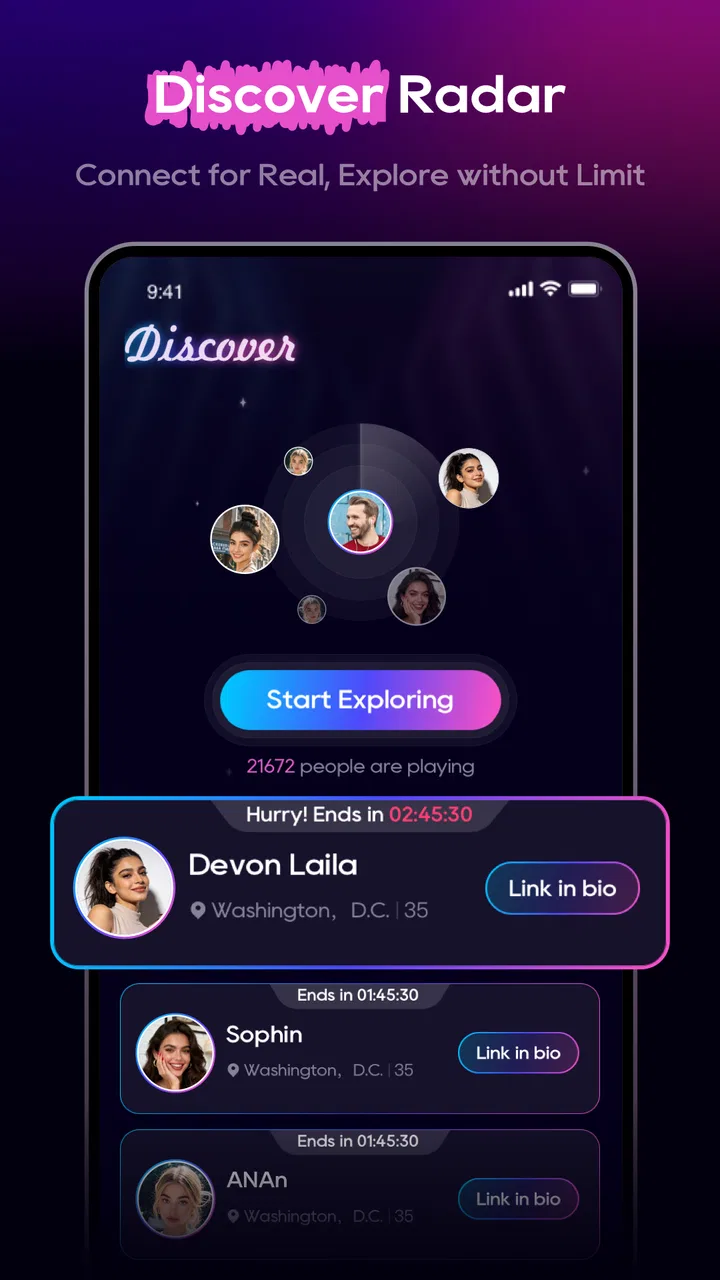
That distinction matters. Many apps in this category try to serve every possible dating style at once, filling the screen with layered profiles, prompts, recommendations, and paid extras. Bold feels more focused on immediacy. The nearby angle gives the app a practical purpose: instead of browsing an abstract pool of people, you can think about connections that might realistically fit your day-to-day life. I found that appealing, especially when distance and convenience matter more than an elaborate compatibility score.
Bold is a free social app from Robo Technologies, with a mature audience in mind. Its store rating sits at a strong 4.7 average from around two thousand ratings, and it has passed ten thousand installs. Those figures suggest that the app has found an audience, although its smaller footprint also means it does not have the same broad reach as the biggest established dating services. That trade-off is central to the experience: a more focused community can feel useful, but local activity will vary considerably from one place to another.
You May Also Like

 AccuWeather: Weather Radar
AccuWeather Review: A Quick, Clear Forecast for Everyday Decisions
For everyday plans, the best forecast is the one you can understand quickly. AccuWeather makes rain timing, radar, and local conditions easy to act on, with a few trade-offs.

 Hill Climb Racing
Why Hill Climb Racing Still Turns Crashes Into One More Run
A tiny car, a bumpy hill and one more upgrade: Hill Climb Racing keeps resurfacing because its simple chaos makes every near-miss feel personal.

 AliExpress - Shopping App
AliExpress Makes Global Shopping Feel Personal, but Shoppers Bear the Risk
AliExpress turns a global marketplace into a pocket-sized discovery engine. Its reach is useful, its shopping loop compelling, and its trade-offs easy to miss.

 Lords Mobile: Kingdom Wars
Lords Mobile Is a Kingdom-Building Routine, Not a Quick Match
A case-by-case verdict on the building, battles, device demands, and social commitments that make Lords Mobile rewarding for some players and exhausting for others.

 PDF Scanner app - TapScanner
TapScanner Makes Paperwork Easier to Capture, Check, and Share
TapScanner makes scanning with a phone feel less like a rescue operation and more like a dependable step in getting work done. Its capture tools are useful, though not flawless.

 Block Blast!
 Shows How Much a Puzzle Game Can Leave Out
A quiet grid game shows why puzzle players increasingly value instant clarity, repeatable skill and low-pressure play—and where the genre still needs to catch up.
More From Our News Desk
View All News


How the nearby-first approach feels in everyday use
The most convincing part of Bold is the way it frames discovery around proximity. I can imagine opening it after moving to a new neighborhood, returning to a city after a long absence, or simply deciding that online conversations should have a realistic chance of becoming an in-person meeting. That is a more useful starting point than matching with someone who looks ideal on paper but lives too far away to fit naturally into your routine.
A realistic example would be someone with a busy workweek who has little interest in maintaining a long-distance conversation. During a lunch break, that person could browse local possibilities, respond to a promising match, and decide whether the conversation deserves more attention later. The value is not that every nearby profile will be compatible. The value is that the app helps reduce one common source of wasted effort: building momentum with someone who is impractical to meet.
The immediate chat emphasis also makes Bold easier to understand than apps that hide conversation behind several layers of interaction. Once there is mutual interest, the next step is obvious. That clarity is useful for people who prefer action over endless browsing. I also think it suits users who are comfortable making an early judgment from limited information, because the app’s appeal depends on moving from discovery to conversation without treating matching as the final goal.
There is a subtle trade-off here. Nearby discovery can make an app feel more relevant, but it can also make the available pool feel repetitive in a smaller community. If you live in a densely populated area, the concept has more room to work because there are likely to be enough potential connections within a practical distance. In a less active location, the same local focus may become restrictive. I would not judge Bold only by its first session; I would give it enough time to see whether the local selection feels alive rather than assuming the entire service is empty.
One useful habit is to treat the first pass through profiles as a filtering exercise, not a race. Because the app encourages quick discovery and chat, it is tempting to start several conversations at once. I found that a smaller number of thoughtful conversations is more manageable. It also makes it easier to notice whether someone is genuinely responsive, whether the exchange feels balanced, and whether the connection has any substance beyond the initial match.
Another practical point is to keep the app’s local promise realistic. Being nearby does not automatically mean being available, compatible, or interested in meeting soon. I would use location as a first filter, then pay attention to communication quality. This is where Bold benefits from a user who brings patience and common sense. The app can shorten the distance between discovery and conversation, but it cannot replace judgment.
What Bold does better than familiar alternatives
Compared with a general social network, Bold has a clearer purpose. Traditional social platforms are useful for keeping up with people you already know, joining broad communities, or discovering content. They are not always designed to turn local interest into a direct personal conversation. Bold removes much of that ambiguity. You are there to find a connection, and the app’s structure supports that intention.
Compared with large dating services, Bold’s local identity is its clearest point of difference. Bigger alternatives may offer larger audiences, more profile tools, or more refined discovery systems. Their scale can be a major advantage if you want maximum choice. At the same time, a huge pool can encourage endless swiping and make the experience feel detached from real life. Bold is more appealing when you would rather have a practical nearby shortlist than an enormous catalog of possibilities.
I would also compare it with messaging apps, but only carefully. Messaging platforms are usually better once you already know someone or belong to a shared group. Bold is designed for the earlier stage, when you are trying to find a new person in the first place. That makes it more purposeful than sending a cold message through a general network, though it also means the quality of the experience depends heavily on how well users present themselves and communicate.
The app’s mature rating is another important part of the decision. I would not interpret that label as a promise that every interaction will be serious, respectful, or suitable for every adult. It is a signal that Bold is intended for mature users, and anyone joining should still set personal boundaries, avoid sharing sensitive information too quickly, and arrange first meetings in public places. Those are not optional extras in a location-based social app; they are part of using it responsibly.
The main weakness is not the idea, but the uncertainty around local depth
My biggest reservation is the same feature that gives Bold its identity: the experience depends on having enough active people near you. A nearby-first app can be excellent in one city and underwhelming in another without changing its core design. If your area has limited participation, you may see fewer meaningful possibilities, repeat the same profiles, or spend more time waiting for conversations to develop.
This is a different weakness from a technical flaw. The concept is easy to understand, but local network effects are difficult for any smaller social service. The install base is growing, yet it remains modest compared with the dominant names in the category. I would therefore avoid treating Bold as your only option if meeting someone soon is a priority. Keeping a second, more established service available may make sense while you learn how active Bold is where you live.
The quick path from matching to chatting can create another kind of friction. Some users will appreciate the lack of ceremony, while others may feel that the app does not give them enough context before a conversation begins. If you prefer long profiles, detailed compatibility tools, or carefully structured prompts, a larger dating platform may give you more material for deciding whom to contact. Bold’s strength is speed and locality, not exhaustive background information.
I also think the free label deserves a practical reading. You can start without paying, which lowers the barrier to trying the service, but in-app purchases range from $14.99 to $299.99 per item. That is a wide span, and it means I would inspect each purchase screen carefully before committing. A free download is not the same as a completely cost-free experience, especially if paid options become tempting after you begin matching. My advice is to use the basic experience first and decide whether the local activity justifies spending anything.
That payment structure affects who should use Bold most confidently. Someone who is curious about local discovery can test the app without an immediate financial commitment. Someone who expects premium tools to guarantee better conversations should be more cautious. No purchase can create mutual interest or solve a quiet local community. I would only consider paying after seeing consistent value in the free experience, not as a way to rescue a disappointing one.
Small decisions that make the experience more useful
I found three practical lessons especially important. First, do not confuse a fast match with a promising connection. Use the opening conversation to check whether the other person answers with some effort and respects the pace you set. The local focus makes meeting more feasible, but it also makes it wise to establish basic trust before revealing where you live, work, or spend time regularly.
Second, think about your search radius as a lifestyle choice rather than a technical setting. A person who works from home may be happy to consider a wider local area, while someone with a demanding commute may need connections close to a familiar route. Even without overcomplicating the process, matching distance to your actual routine can prevent attractive conversations from becoming impractical later.
Third, use conversation quality to decide when to stop browsing. It is easy to keep looking because the app is built around discovery, but a promising exchange deserves attention. I would rather explore one or two genuine conversations than collect a long list of matches that never develop. This approach also makes the app feel less like a game of accumulation and more like a tool for finding a realistic connection.
For safety, I would keep early chats inside the app until the person has earned more trust. Avoid sending financial information, identity documents, or private details, and be cautious if someone pushes for secrecy or immediate off-platform contact. If you decide to meet, choose a public location, tell someone you trust where you will be, and arrange your own way home. Bold’s local design can make a meeting feel convenient, but convenience should never replace basic precautions.
Who should try it, and who should choose something else
Bold is a good fit for adults who want to meet people close to home and prefer a straightforward route from discovery to conversation. It is particularly suitable for someone new to an area, someone tired of long-distance matches, or someone who wants social and dating possibilities grounded in everyday geography. If you like making your own decisions from a small amount of information and do not need a huge collection of profile tools, the app’s direct style may feel refreshing.
It may also work for users who are willing to help build a local community. Smaller services benefit from people who reply thoughtfully, maintain an honest profile, and give conversations a fair chance. If everyone joins only to browse and leaves after a quiet first session, the local pool never has an opportunity to become useful. A patient early adopter may get more from Bold than someone expecting the density of a household-name platform immediately.
I would skip it if you need a large, highly active audience in every location, or if detailed compatibility systems are the main reason you use dating apps. People who dislike location-based discovery should also look elsewhere, as proximity is not a minor feature here; it shapes the whole proposition. Likewise, if you want a completely free service with no expensive optional purchases to consider, the in-app pricing range deserves caution.
Device compatibility is reasonably broad for an app of this kind. The current version is 1.66.0 and supports Android 7.0 or later, so many older Android phones can run it. I would still keep the app updated when possible, especially for a social service where reliability and communication matter. The release date is January 29, 2026, which also places it among newer options rather than a long-established network with years of accumulated reach.
My final view after weighing the trade-offs
Bold: Local Chat & Date has a clear thesis, and I appreciate that it does not need a complicated explanation. It tries to make new connections feel more immediate and more realistic by putting nearby people at the center. In my experience, that gives it a useful identity in a crowded social category. The best moments come when the local pool is active and a quick match turns into a conversation that could plausibly continue offline.
Its limitations are equally clear. The service cannot escape the challenge of local participation, and its simpler approach may leave some users wanting richer profile context or more sophisticated matching. The mature audience and broad in-app purchase range also mean that I would use it deliberately rather than casually handing over attention or money. A strong average rating is encouraging, but it should not override the question of whether your own area has enough active people.
My recommendation is to try the free experience with modest expectations, spend time assessing the quality of nearby conversations, and avoid paying until the app proves useful in your location. If you want a direct local social tool and are comfortable taking responsibility for your own filtering and safety, Bold is worth a look. If you want the widest possible audience or a deeply structured matchmaking system, a larger alternative will probably serve you better.
Overall, I see Bold as a focused option rather than a universal replacement for every dating app. Its real strength is turning “nearby” into the starting point for a conversation, not merely a label on a profile. That makes it promising for the right user, but the right user is someone who values practical distance, can tolerate a developing community, and is prepared to judge connections with care.
FAQs for Bold: Local Chat & Date
01What is Bold: Local Chat & Date, and how does it work?
Bold: Local Chat & Date is a social and dating app designed to help you discover and connect with people nearby. After creating a profile, you can browse local users, view shared interests and photos, and interact through chat or other available matching features. The experience is focused on location-based discovery, so the quality of results may depend on how many active users are in your area.
02Is Bold: Local Chat & Date free to download and use?
The app can generally be downloaded for free, but some features may require in-app purchases or a premium subscription. Basic access may include profile creation, browsing, or limited communication, while advanced options can vary according to the current version and region. Before subscribing, review the pricing, renewal terms, and cancellation policy shown in the app store or within the application.
03Does Bold: Local Chat & Date protect my privacy and location information?
Because Bold relies on local discovery, it may request access to your location and other information needed to create or personalize your profile. You should check the permissions requested during setup and read the app’s privacy policy before continuing. Avoid sharing your exact address, workplace, financial details, or other sensitive information with people you have only recently met online.
04Can I use Bold: Local Chat & Date safely when meeting someone new?
The app can help you start conversations, but it cannot guarantee that every profile is genuine or that every interaction will be safe. Keep early conversations inside the app, watch for requests for money or personal information, and report suspicious behavior. If you decide to meet, choose a busy public place, tell someone you trust, and arrange your own transportation.
05What should I do if I experience unwanted messages or find a suspicious profile?
If another user behaves aggressively, sends inappropriate content, appears dishonest, or repeatedly contacts you after you have said no, use the available block and report tools immediately. Do not feel pressured to continue a conversation or move it to another platform. Save relevant evidence when appropriate, review your privacy settings, and contact official support if the problem cannot be resolved through in-app controls.
Pros
- No phone number is required to start chatting with nearby users.
- Location-based discovery can make local conversations feel more relevant.
- The interface is simple to navigate
- even for first-time users.
- Useful for meeting people around events
- neighborhoods
- or shared places.
- Profile-based matching helps users choose conversations more selectively.
Cons
- The usefulness of the app depends heavily on how many locals are active.
- Location access may raise privacy concerns for cautious users.
- Some conversations may be low-quality
- inactive
- or quickly abandoned.
- Users should remain alert because identity verification may be limited.
- Battery and data use can increase when location features run frequently.

Bold: Local Chat & Date
Gallery